Avenidas, Palo Alto · Community talk
Caring Across the Miles
The long-distance caregiving landscape — and how care flows in both directions.
Xiaojing Xing (M.S.) · Crane Huang (Ph.D.) · Stanford University School of Medicine
Part 1 · The long-distance landscape
National data on older adults and their children shows that living far from your children is not unusual — it is a normal part of modern family life.
26%
of older adults live in the same home as an adult child
~1 in 4
have their nearest child farther than 10 miles away
6%
have their nearest child 500+ miles away
Care usually starts or grows after a health event — a fall, a hospital stay, a new diagnosis. From a distance, the work shifts toward coordinating and checking in rather than hands-on help.
Source: Health & Retirement Study analyses; AARP & NAC, Caregiving in the U.S. 2025.
Part 2 · Care flows both ways
Caregiving is not a one-way street. Adult children give to parents — and parents keep giving back. What we presented draws on interviews with more than 20 families.
Children → parents
What they worry about, what they wish they knew, what they want to do — from national research and our interviews with 20+ families.
Parents → children
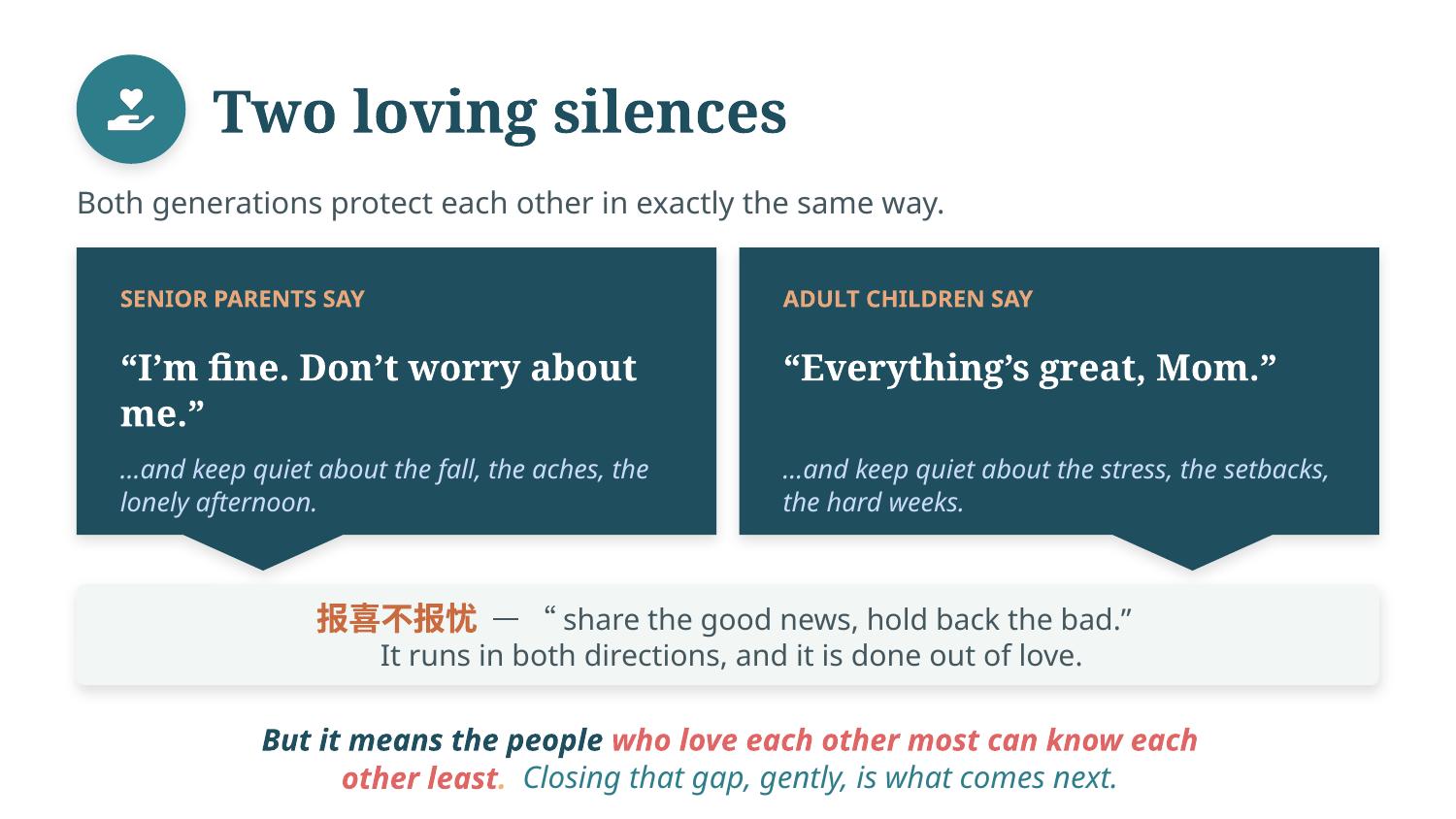
“I’m still the parent.” “Talk with me, not at me.” “I’m not a burden.” Parents protect their children from worry by keeping quiet about their own.
Parents never stop giving
Research is clear: giving to your children is good for parents, too. Their wellbeing rises and falls with their children’s — at every age.
Part 3 · Best practices
Several things families can do together to give each of them peace of mind.
1. Stay connected, without surveillance
Cameras and sensors are often tried and often abandoned. What works better: simple daily check-ins, sharing what you already do, and choosing what to share and with whom.
2. Combat loneliness with small habits
One photo a day. A game with family. A standing call on the same day each week. And in-person community — you’re already in the right place.
3. Plan ahead as an act of love
An “in case of emergency” list takes 30 minutes. Have the conversation you’ve been putting off. Tell someone your story.
The talk is based on research with families and interviews conducted in 2026. It presents what we heard and what the literature supports — not a product or a clinical assessment.
Additional sources: Pew Research Center (2022); Choi et al. (2020), Journal of Marriage & Family; Hay et al. 2008; Age UK 2023; Fingerman et al. 2012; Byers et al. 2008; Guo et al. 2018; Jukema et al. 2019.