MCiM ’26 · Stanford School of Medicine practicum
The Actionable Decade
Cross-domain decoupling as an actionable signal for early intervention in mid-to-late life.
Kate Xing · Sun Kim · Crane Huang
Aging is not one trajectory.
Someone can remain physically independent while their social connections, cognition or financial security move in different directions. Our practicum examines this divergence—“decoupling”—and the opportunity to act before clinical frailty.
Using the U.S. Health and Retirement Study, we analyzed seven domains: physical health, functional ability, cognition, mental health, social connection, financial security, and housing/environment. The decoupling score measures the spread across a person’s standardized domain scores, not their overall level of health.
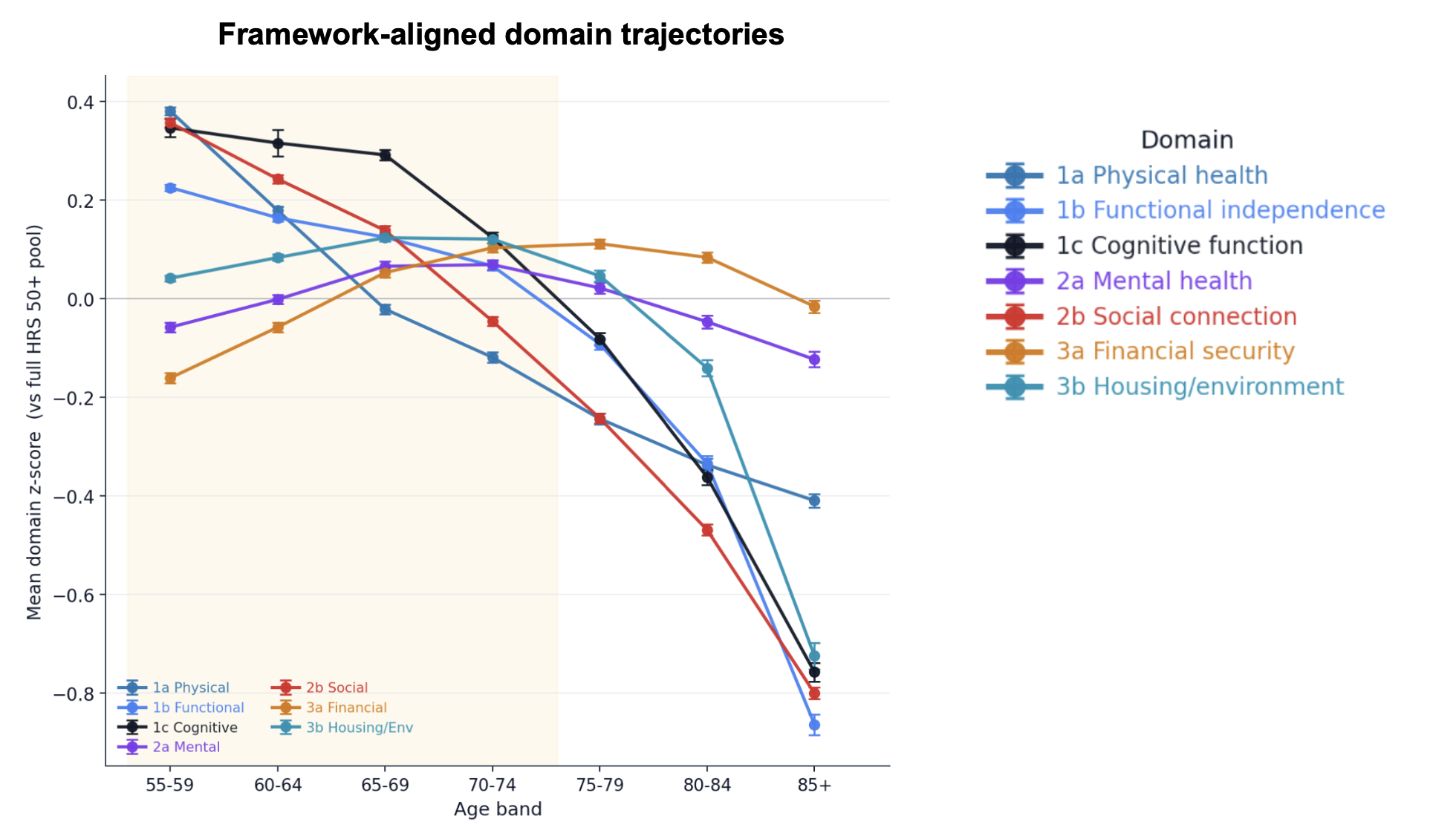
What the analysis found
- ≈44,320
- individuals across approximately 251,800 person-wave observations, 1992–2022.
- 55–74
- the early-intervention window identified by the practicum, before later-life trajectories diverge more sharply.
- ≈1.4×
- functional-deficit burden at 85+ in the high versus low baseline-decoupling groups, measured at ages 55–69.
Findings reported in the practicum paper, Abstract and Sections 2–3. These are observational associations, not proof that an intervention prevents disability.
From signals to support
The research points to three intervention priorities. These are proposals for future testing, not products or clinically validated treatments.
Ages 55–65
Notice psychosocial change earlier
Explore passive signals of mental health and social connection within everyday tools, before changes become entrenched.
Ages 55+
Follow the whole person over time
A longitudinal health companion could connect physical, functional and cognitive changes rather than treating each stage of aging in isolation.
Ages 60–74
Support consequential financial decisions
Bring health-aware planning, benefits navigation and fraud protection into the years when Social Security and Medicare decisions cluster.
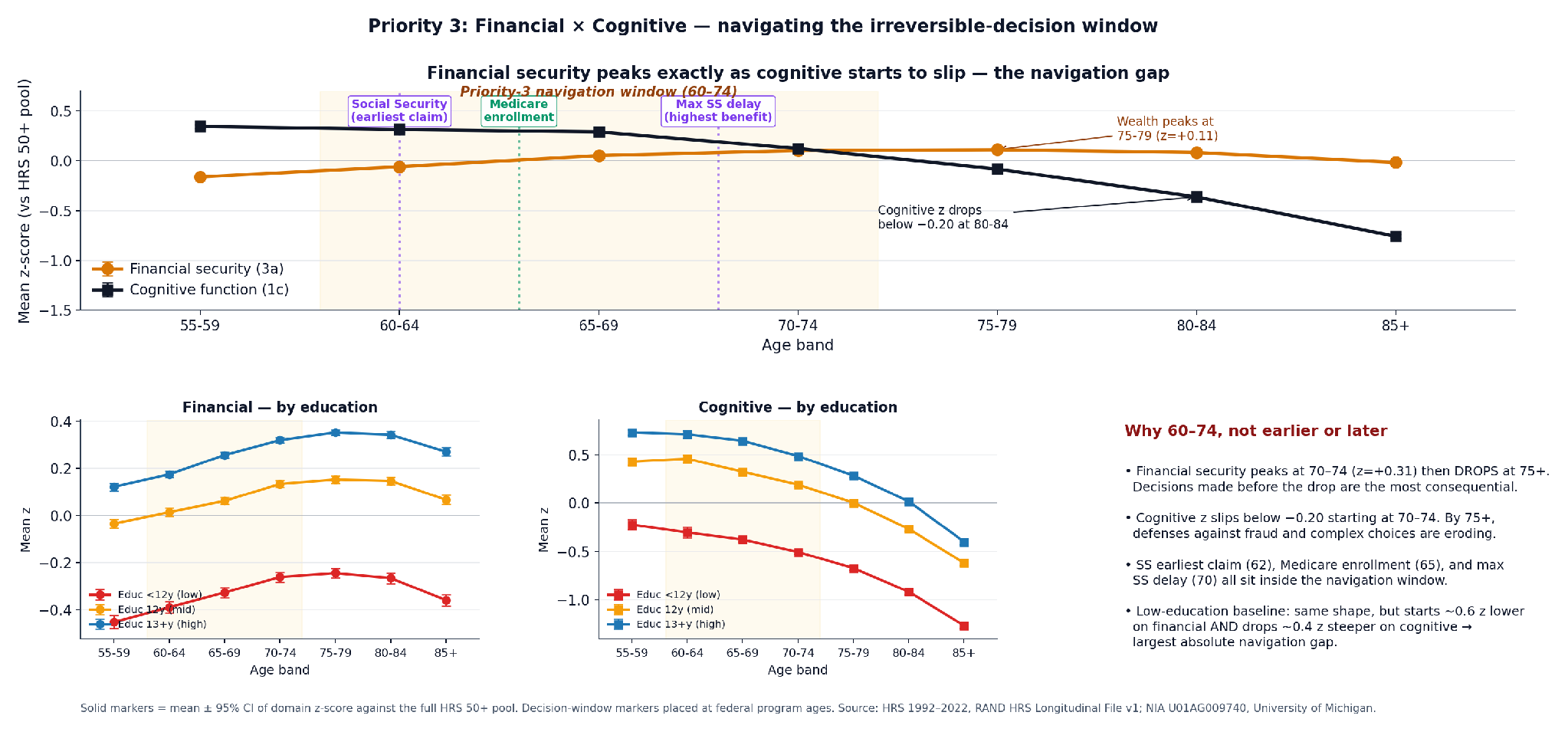
Agency comes first.
The paper calls for non-stigmatizing, mastery-framed care embedded in existing behavior: detect divergence unobtrusively, preserve agency, and explore low-friction cognitive signals through ordinary interactions.
What still needs to be tested
The score uses single-wave snapshots and available HRS proxies. Missing data, repeated observations and survival selection limit interpretation. The financial pathways are U.S.-specific, and the proposed digital interventions require randomized evidence. This is a student practicum, not a clinical assessment tool.
‹ All work